Finance infrastructure
Generic Database MCP vs a Governed Finance MCP Server
Both can let an AI client retrieve data. Only one makes finance operations, definitions and scope the contract.
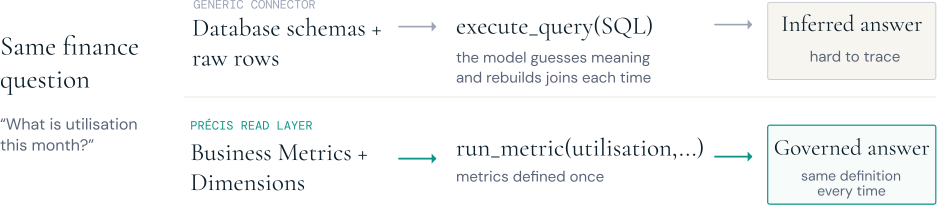
A generic database MCP server and a governed finance MCP server can both let an AI client retrieve data. They do not give the client the same contract.
The generic route exposes database capability: inspect a schema, write or run a query and return rows. The finance route exposes approved financial operations: retrieve a named statement, calculate a governed metric, compare scenarios, drill through an authorised hierarchy and inspect permitted supporting detail.
Neither approach is universally better. The right choice depends on whether the client is exploring data or producing a financial answer someone must be able to explain and stand behind.
The short comparison
| Question | Generic database MCP | Governed finance MCP |
|---|---|---|
| Primary contract | Database access | Finance operations |
| Client sees | Schemas, tables and query capability | Metrics, statements, scenarios and hierarchies |
| Financial meaning | Inferred by the client or encoded in each query | Defined in a governed catalogue and semantic views |
| Calculation | Often client-authored SQL | Deterministic finance engine |
| Time comparisons | Period shifts and variance logic rebuilt in SQL or client code | Named actual-versus-plan, prior-period and year-on-year comparisons |
| Period roll-up | Each query decides whether to sum, average or take a closing value | sum, avg or closing behaviour defined per metric |
| Statement output | Rows need separate presentation logic | Ordered lines, sections, subtotals, formats and scenario columns |
| Variance interpretation | Numeric sign may be mistaken for favourable or unfavourable | Metric-specific natural, inverse or neutral variance treatment |
| Permissions | Service credentials, database roles, row-level security or connector-specific controls | Platform identity plus tool, data-domain, scenario and dimension scope |
| Enforcement | Depends on the database and connector implementation | Effective finance scope applied server-side before retrieval; the agent cannot widen it |
| Traceability | Query and returned rows | Definition, dimensions and route towards permitted detail |
| Best fit | Exploration, engineering and low-risk internal querying | Repeatable financial analysis and reporting |
A valid query can still be financially wrong
Suppose a user asks for Q1 gross margin against plan by business unit. The database may contain every required row, but the query still needs answers to finance questions:
- Which accounts make up revenue and direct cost.
- Which named plan version is meant.
- How the fiscal quarter maps to source periods.
- How cost centres roll into business units.
- Whether the percentage is stored, averaged or recalculated.
SQL can be syntactically valid and return a plausible result while choosing the wrong answer to one of those questions. The problem is not necessarily the language model. A human analyst new to the schema would need the same context.
What a generic database MCP does well
A generic connector is useful when the goal is to explore unfamiliar data, support engineering work, prototype a query or access a database whose business logic is already completely encoded in stable views.
It is also simple to reason about: the server exposes database capability and the client authors the query. For technical users working inside a controlled environment, that can be exactly the right abstraction.
The limitation appears when the client becomes responsible for reconstructing financial policy from schemas, prompt context or previous queries. Repeating a prompt is not the same as governing a definition.
What the governed finance route adds
A governed finance MCP narrows the available operations and deepens their meaning. Instead of arbitrary table access, the client discovers named scenarios, approved metrics, statement layouts and supported hierarchies. It asks the server to run one of those operations; deterministic code resolves the definition and queries the approved semantic views.
That contract adds:
- metric grain, units and aggregation behaviour;
- chart-of-accounts mappings and ordered statement layouts;
- named actual, budget, forecast and comparison scenarios;
- hierarchy-aware drill-down;
- fail-closed dimension and operation validation;
- caller scope applied before retrieval; and
- source context returned with the result.
The language model can interpret the user’s wording and select an operation. It does not calculate the figure in its response.
Finance behaviour is part of the server contract
A generic database MCP can return the rows needed for a comparison. It does not inherently know how finance expects that comparison to behave. In Précis, these behaviours are implemented by the finance engine and selected through governed catalogue definitions.
| Finance requirement | Governed finance engine | Generic database MCP |
|---|---|---|
| Actual versus plan | Calculates signed and percentage variance between named scenarios | Requires comparison SQL or client logic |
| Year-on-year | Resolves the prior-year period and performs the comparison deterministically | Requires the client to shift periods correctly |
| Period roll-up | Applies sum, avg or closing according to the metric | Usually leaves the aggregation choice to each query |
| Non-additive metrics | Recalculates rates and margins from their components at the requested grain | May sum or average percentages incorrectly |
| Accounting signs | Applies the configured display treatment—for example, presenting credit-side revenue as positive | Returns the stored ledger sign unless each query changes it |
| Favourability | Interprets variance as natural, inverse or neutral—for example, a cost overspend is unfavourable | A positive numeric variance may be incorrectly presented as favourable |
| Financial statements | Returns ordered lines, sections, subtotals, indentation, formats and scenario columns | Returns rows that another implementation must turn into a statement |
| Hierarchy drill-down | Preserves the approved roll-up and returns the permitted child level | Requires custom joins and hierarchy logic |
The agent chooses the governed operation and requested comparison. It does not recreate this accounting logic in SQL or rely on prompt memory.
The customer still defines its chart-of-accounts mappings, reporting structures, scenarios and finance policy. The difference is that those decisions are configured once and applied consistently by the engine—rather than reimplemented in every query, workbook or agent conversation.
Governance is more than read-only SQL
Read-only database credentials are an important control. They prevent mutation; they do not determine whether the caller should see every scenario, entity, cost centre or source row available to that credential.
Transport authentication can identify the caller. It does not by itself express a finance policy such as “this manager can read actuals and forecast for Division North, but not the rest of the group.”
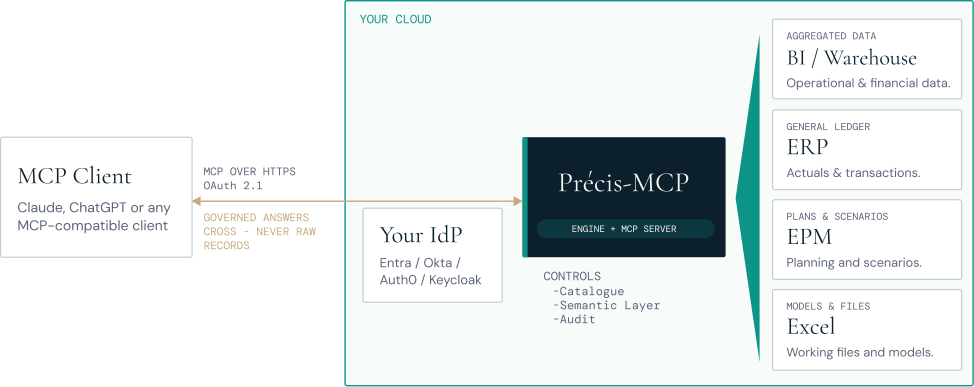
In Précis, an access profile can grant specific finance data domains and scenarios, then narrow them by dimension—for example, business unit, entity or cost centre. Each tool also has a declared access class. When the client makes a tool call, the server resolves the caller’s profile and intersects the requested filters with the permitted scope before retrieval. That effective scope is injected below the agent; neither the user nor the model can remove or widen it.
A generic database MCP can be secured to the same standard, but the equivalent policy usually has to be represented through database accounts, native row-level security or custom connector logic tied to the physical schema. The Précis access model is expressed once in finance terms and reused across the application, Excel and external MCP routes.
This does not remove the need to secure the underlying database, deployment or identity provider. It provides a finance-aware application boundary above them.
Next: Review the complete Précis deployment and trust boundary.
Traceability changes the review
A database result can show the SQL and rows returned. A finance result also needs the definition and context that made the total meaningful. The reviewer should be able to identify the statement or metric used, scenario, period, filters and available route towards the permitted source detail.
That is the difference between reproducing a query and reviewing a financial answer. Both matter; finance needs the second.
- Governed metricGross margin uses the approved revenue and direct-cost definitions.catalogue/pnl.yml · gross_margin_pct38.5%
- Authorised semantic queryQ1 actuals resolve within the caller's organisational scope.semantic.v_pnl · scope applied before retrievalQ1 2026
- Permitted source contextThe result retains the dimensions finance needs for review.actuals · period · account · cost centre
| Period | Scenario | Account | Cost centre | Amount |
|---|---|---|---|---|
| 2026-Q1 | Actuals | 4000 Revenue | CC-100 | 1,816,420 EUR |
When to use each approach
Use a generic database MCP when the user is technically qualified, the work is exploratory, the data has low financial consequence or the governed logic is already fully expressed in the database objects being exposed.
Use a governed finance MCP when the same questions repeat, multiple clients must use the same definitions, scenario and hierarchy meaning matters, access needs to follow finance scope, or the answer will feed reporting and decisions.
Some organisations will use both. A data team may keep a generic connector for engineering while finance uses a narrower governed interface for repeatable analysis.
Where Précis Finance MCP fits
Précis Finance MCP is the source-available, self-hosted read engine beneath the full Précis platform. It exposes statements, metrics, comparisons, hierarchy discovery and permitted detail over a YAML finance catalogue and semantic SQL views. It is read-only by construction.
The full Précis platform adds the finance workflow around that engine: routine preparation, ad-hoc work, scenarios and reports finance reviews and signs off.
Next: Explore Précis Finance MCP or review the deployment and trust boundary.