Finance Intelligence Platform · Pre-General Availability

Finance that moves at the speed of your business.

Précis takes the mechanical data work off your team's hands — the pulling, reconciling, and formatting that fills month-end — so their time goes to judgement: challenging the business, improving forecasts, making the call. Every figure traces to your chart of accounts. Précis prepares; your team decides.

Précis Board pack
Board pack · FY26 EBITDA outlook

FY26 EBITDA — strategic walk from FY25

  • Atlas (Cloud) and Forge (utilisation) cover Beacon's investment-year drag and the wage step-up.
  • Pulse rate-card increase on cycle; renewals concentrated in Q2 and Q3.
  • Net build: +€400K on the FY25 base, two-thirds from operational programmes.

Strategic programmes · €K · NovaTech Solutions GmbH
FY25 → FY26 EBITDA walk

0 1,375 2,750 4,125 5,500 €K 3,890 FY25 EBITDA +420 Atlas −180 Beacon +280 Forge +220 Pulse −340 Wage 4,290 FY26 plan
1 Strategic programmes defined per FY26 plan v2.1; figures in €K.
2 EBITDA on management basis; statutory reconciliation in appendix A2.

The problem

Your team's time goes to assembling numbers, not interrogating them.

The time gap

Most of the month goes to gathering, reconciling, and formatting. The analysis that actually needs your team's expertise gets whatever time is left.

The speed gap

The business changes weekly; the reporting cycle answers in weeks. By the time the pack lands, the decision has already moved on.

The trust gap

The logic behind a forecast lives in someone's spreadsheet and someone's head. When they're unavailable, the reasoning leaves with them.

What Précis is

An agent in the middle

The team asks in plain language. Précis retrieves, reconciles, and prepares the figures across the systems you already run on.

Précis sits between your finance team and the systems you already run. The team asks in plain language; Précis retrieves, reconciles, and prepares the figures across your ERP general ledger (actuals and transactions), EPM (plans and scenarios), BI and warehouse (aggregated operational and financial data), Excel (working files and models), and other context (headcount, pipeline, KPIs). It returns prepared work: a variance pack, ad-hoc analysis, scenario modelling, and a management report.

Précis is not a replacement for your planning system, dashboard or Excel — you have those. It connects to your actuals and your plans, understands your chart of accounts and cost-centre hierarchy, and does the work finance still does by hand: the routine reporting, the ad-hoc questions, the scenarios, the management packs. It runs structured operations against your data — it does not generate figures from a language model. Every number traces to account, cost centre, period, and scenario. When the data isn't there, it tells you.

In your spreadsheet

The numbers your team needs, in the spreadsheet they already work in.

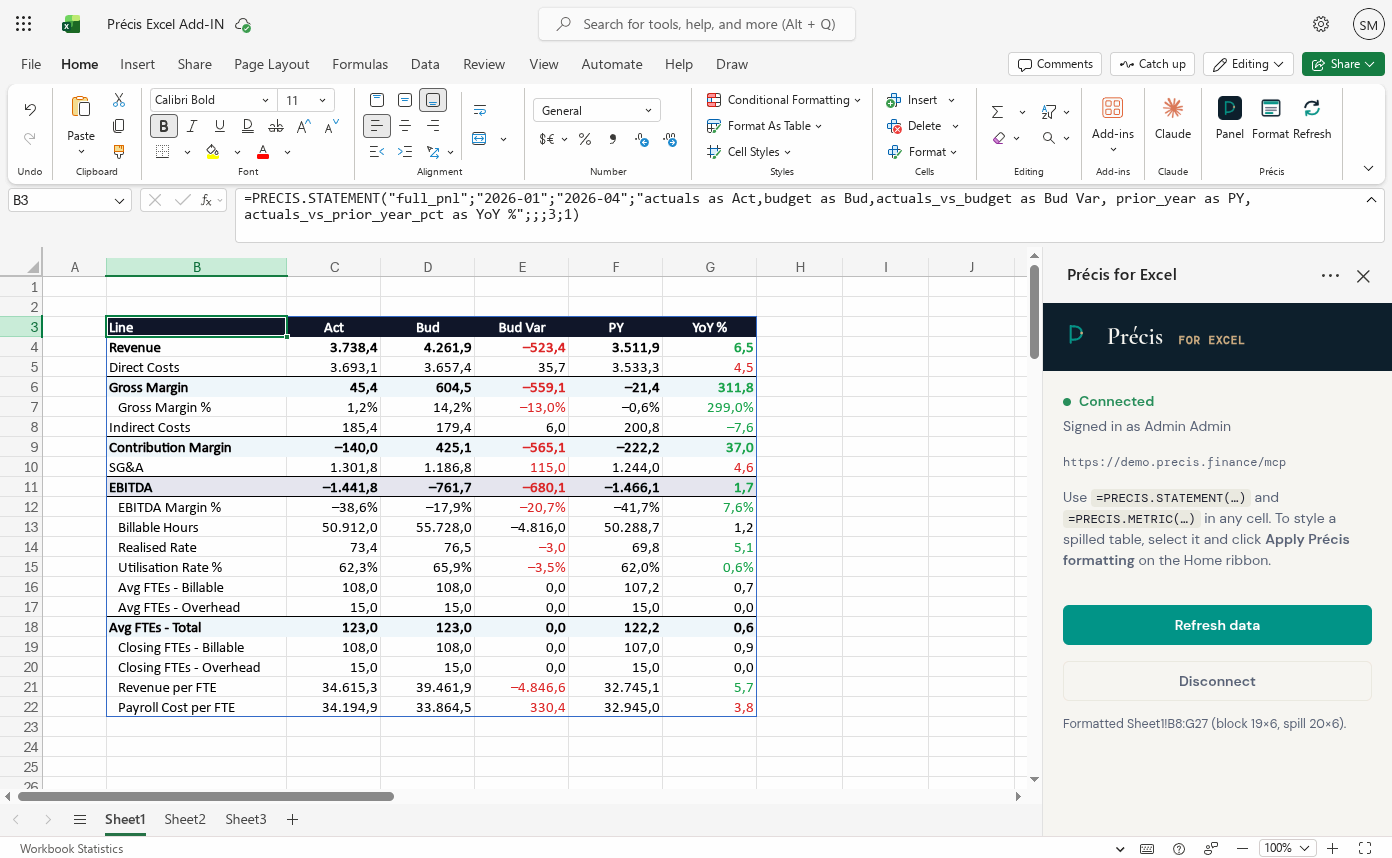
Your team isn't leaving Excel — and they shouldn't have to. Précis brings the figures to them. Type a formula like =PRECIS.STATEMENT(…) or =PRECIS.METRIC(…) and a live statement or metric spills straight into the sheet — the same figures Précis prepares everywhere else, refreshed on demand and traceable to source. No copy-paste from another system, no stale export. A ribbon button applies Précis formatting to the result; signing in takes one click. It works in desktop Excel and Excel on the web.

Précis for Excel: the formula =PRECIS.STATEMENT(…) spills a formatted financial statement into the grid — Revenue through EBITDA with Actual, Budget, Budget Variance, full-year and year-on-year columns — alongside the Précis task pane showing a connected, signed-in session and a Refresh button.

Open core

The engine behind Précis is yours to inspect and run. Proof, not a promise.

The read-only engine at the core of Précis — the part that retrieves your numbers and serves them to an AI client — is source-available and self-hostable. It is read-only by construction: it can read a P&L, a variance, a margin and drill into the detail behind them, but it cannot change your data or invent a figure. You can run it on your own infrastructure, inspect every line, and point Claude or any MCP-capable client at it today. That is how "every figure traces to source" becomes something you verify, not something you take on faith.

Précis Reasoning chain
Figure cited
€1.82M (−€420K vs. plan)
Q1 2026 EMEA revenue. Two enterprise engagements slipped to Q2 — the variance is concentrated, not structural.
Trace to source
  1. Plan figure — Q1 2026 EMEA revenue
    Locked budget v2.1, signed off by FP&A on 2025-12-15.
    Plan store · scenario novatech-fy26-plan-v2.1
    €2.24M
  2. Actual figure — Q1 2026 EMEA revenue
    GL close posted 2026-04-08 across DE, FR, BE legal entities.
    ClickHouse · semantic.revenue_by_region · 2026Q1
    €1.82M
  3. Variance — Project Atlas slipped to Q2
    Phase-1 €312K signed but billable from May 2026; not in Q1.
    CRM · engagement #ENG-2845
    −€312K
Source ledger row
PeriodRegionAccountAmountPosted
2026-Q1EMEA4000 Revenue · Services1,816,420.00 EUR2026-04-08

Design-partner phase

We're building Précis with a few finance teams.

Précis is pre-General Availability. We're working with a small number of finance teams who want this work taken off their hands and are comfortable shaping a product alongside us. Design partners get the platform deployed in their own cloud, hands-on help from first ingestion to first board pack, and a direct line into what we build next.

Précis deployed in your cloud: an MCP client reaches Précis (engine and MCP server) over an authenticated channel, while your warehouse, ERP, EPM and Excel sources, your identity provider, and your controls all stay inside your cloud perimeter — only governed answers cross the boundary.